Supplier sustainability management
The company's internal control system has a "Supplier Selection Management Procedure Book". For procurement management, appropriate material suppliers and engineering contractors fill in the "Supplier Basic Information". The second is to "Supplier Evaluation Form" Suppliers pay attention to environmental protection, occupational safety and health and other items to conduct self-evaluation. The company and its suppliers use various methods to strengthen the promotion of the corporate social responsibility policies followed by the company during the trade process.
In formulating new supplier assessments and annual supplier assessments, the company takes stock of the overall status of suppliers step by step, and works together with Shangpin to achieve the goal of sustainable development
In order to fulfill our corporate social responsibilities with suppliers who provide services, supply relationships and business dealings, our company is committed to assisting suppliers in paying attention to issues such as environmental protection, safety and hygiene, so as to promote the practice of balanced and sustainable development of the economy, society and the environment. The supplier's social responsibility commitment letter is formulated as follows: The supplier's commitment should be based on the principle of good faith management, conduct transactions in an open and transparent manner, pursue sustainable business operations and profits, and fulfill the practice of corporate social responsibility and abide by labor laws. Rights and human rights, environmental protection, integrity management ethics and other relevant laws and regulations, and is committed to helping suppliers pay attention to environmental protection, safety, health and other issues to promote the balanced and sustainable development of the economy, society and environmental ecology. The supplier declares that it will do its best to fulfill its corporate social responsibilities. If there is any violation of the aforementioned laws, it will cooperate with the competent authorities or the company's requirements to improve within the time limit, and regularly provide the company with the improvement processing situation for follow-up review until the improvement is completed.
Supplier signing status of joint commitments in 2025:
| Category | Committed quantity | Signature ratio |
|---|---|---|
| Iron | 2 | 7.7% |
| Plastic | 6 | 23% |
| System Engineering Category | 8 | 30.8% |
| Others | 10 | 38.5% |
| Total | 26 | 100% |
Please click on the link to Supplier Code of Conduct
Implementation status of Supplier Code of Conduct:
1. Sustainable Supply Chain Policy and Advocacy
Starting in the first half of 2025, the Company officially adopted the Responsible Business Alliance (RBA) Code of Conduct as its own Supplier Code of Conduct. This policy was published on our external website and communicated to suppliers via official correspondence in July of the same year. The scope of this advocacy covers: A. Labor Rights; B. Health and Safety; C. Environmental Standards; D. Business Ethics; and E. Relevant Management Systems.
In 2025, we completed the dissemination of the Code of Conduct to 79 suppliers. Through the use of questionnaires, we ensured that these suppliers fully understood the requirements and remained aligned with the Company’s objectives, fostering a collaborative, sustainable supply chain.
2. Implementation of Supplier Audits and Guidance Mechanisms
To effectively monitor the implementation of Corporate Social Responsibility (CSR) among our suppliers, the Company developed a "Supplier CSR Assessment Form." We conducted comprehensive evaluations of 79 key material suppliers, focusing on: labor rights and compliance with labor regulations, environmental management and pollution control, and progress in carbon footprint inventory.
Regarding on-site audits, in 2025, we performed in-person inspections at 6 supplier facilities—primarily within the chemical solvent and steel-related sectors. These audits were conducted in accordance with our publicly disclosed Supplier Code of Conduct. We also provided professional guidance and recommendations for improvement, helping to mitigate legal and brand-related risks while ensuring supply chain compliance.
3. Green Management, Occupational Safety, and Key Performance Highlights
The Company places a high priority on green procurement and workplace safety. We regularly evaluate our suppliers' green management performance, while simultaneously strengthening environmental awareness and green management training for our own employees. Furthermore, we maintain strict controls over hazardous substances and controversial raw materials.
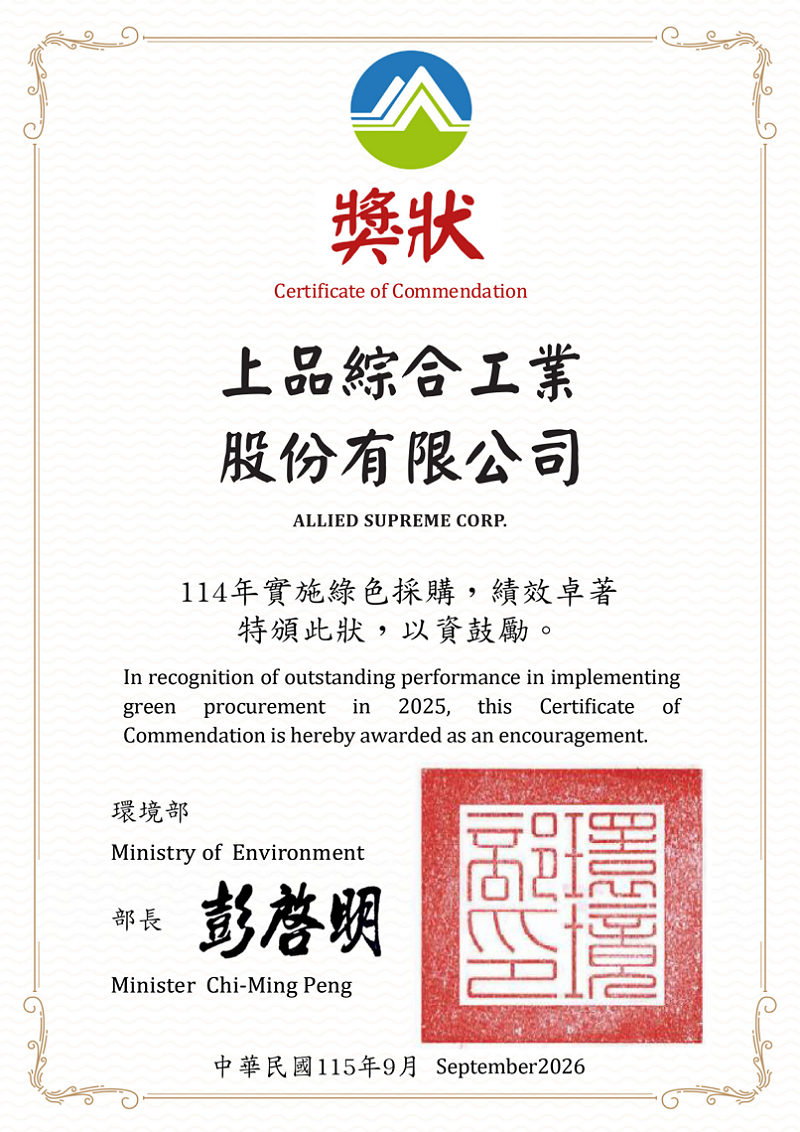
Having launched our green procurement initiative in 2025, we achieved outstanding results in the very first year—earning public recognition from the Ministry of Environment—which underscores our successful, long-term commitment to cultivating a green supply chain.
Moving forward, we will continue to deepen our efforts across four key operational areas—both internally (within production units) and externally (with suppliers): risk assessment, supplier auditing, the development of alternative materials, and the integration of sustainability considerations into product design—as we strive toward a sustainable and mutually beneficial future. During the procurement process, specifications are strictly required to align with the principles and standards of occupational health and safety, ensuring the well-being of all personnel—whether they are working on-site or in office environments. In 2025, our logistics and transportation contracting operations achieved an exemplary record: zero traffic accidents, zero occupational safety incidents, and zero environmental accidents.
Our sustainability assessment questionnaire includes criteria such as the prohibition of child labor, the appointment of occupational health and safety (OHS) management personnel, the implementation of regular health check-ups (already adopted by over 70% of our suppliers), and the establishment of human rights policies. Suppliers who did not provide clear responses have been prioritized for upcoming on-site audits and visits.
4. Verification Mechanism:
We require all new suppliers—those with whom we have no prior business history—to sign a Corporate Social Responsibility (CSR) Commitment. In 2025, we successfully secured such commitments and completed compliance screenings for 26 suppliers.
To foster sustainable procurement, our procurement team maintains regular contact with suppliers and establishes annual supply chain management objectives. These goals encourage continuous improvement across five key areas: labor practices, health and safety, environmental impact, business ethics, and management systems.
Furthermore, we conduct cross-checks using the Ministry of Labor’s "Database of Employers (Business Entities) in Violation of Labor Laws." In 2025, it was identified that two suppliers had breached their commitments and were publicly listed by the competent authorities. We immediately required these suppliers to submit a "Supplier Quality Anomaly Report" within a specified timeframe. Our procurement department reviewed these reports and initiated follow-up monitoring. Adopting a supportive approach, we also provided professional guidance to help these suppliers address their shortcomings and return to full compliance.
In 2025, we communicated our Supplier Code of Conduct to 79 suppliers and utilized questionnaires to assess their level of understanding and implementation. Through this process, we conveyed our firm commitment to sustainable operations and prioritized partnerships with entities that share our dedication to sustainability.
5. Improvement Measures:
We continuously monitor the progress of supplier improvements—through telephone communications, email, or other channels—to ensure that human rights, labor rights, and health and safety standards are upheld. Suppliers and other relevant stakeholders are invited to visit the "Supplier Sustainability Management" section on our official website to learn more about the implementation of these standards and the latest developments.
| Suspended penalties for violations | Communication channels and response methods | Number of households |
|---|---|---|
| No fine for violation | Telephone communication, email | 1 |
| Below NT$ 30,000 | Telephone communication, email | 1 |
| NT$ 30,001 - 100,000 | Email (written improvement report) | 0 |
| NT$ 100,001 - 1,000,000 | Correction of documents and on-the-spot understanding | 0 |
| More than NT$ 1,000,001 | On-the-spot understanding and evaluation of termination of cooperation | 0 |
In 2025, ASC received public recognition from the Ministry of Environment, demonstrating the positive outcomes of its deep commitment to a green supply chain.